
Organisation
The four tabs that decide what prints on a document: your profile and logo, your warehouses, your currencies, and your number series.
Organisation is the screen every document reads from. Your logo, address and registration print on the PDF, your base currency is the one every amount is recorded in, and your number series decide what an invoice is called. Set it up before you raise anything.
Go to SettingsFinanceOrganisation. Four tabs: Profile, Warehouses, Currencies and Number Series.
Profile
The Profile tab is grouped into five sections.
| Field | What it does |
|---|---|
| Organisation InformationRequired | Your logo, Organisation Name, Industry and Organisation ID. The name and logo are what a customer sees at the top of every PDF; the Organisation ID is a read-only reference SorviAI gives you. |
| Address | Address Line 1 and 2, Country, State / Province, City, and Zip / Postal Code. Country also decides what the tax screens call your tax. |
| Contact | Email, Phone, Fax Number and Website, printed in the document footer. |
| Regional Preferences | Timezone, Base Currency and Fiscal Year Start. These three drive dates and totals rather than layout. |
| Accent Color | The colour SorviAI uses through the interface, from a swatch or a Custom Color. |
Warehouses
Your stocking locations, their addresses, and which one is primary. A warehouse is offered on item stock, on stock adjustments and on anything that ships, so a location you have not created here cannot be picked anywhere else.
Currencies
The currencies you can transact in, beyond your base currency, and the exchange rate held against each.
| Field | What it does |
|---|---|
| Currency | The currency code and name. One row is marked Base and cannot be removed. |
| Symbol | What prints in front of an amount in that currency. |
| Exchange Rate | The rate used to convert into your base currency. Refresh exchange rates updates them in one pass. |
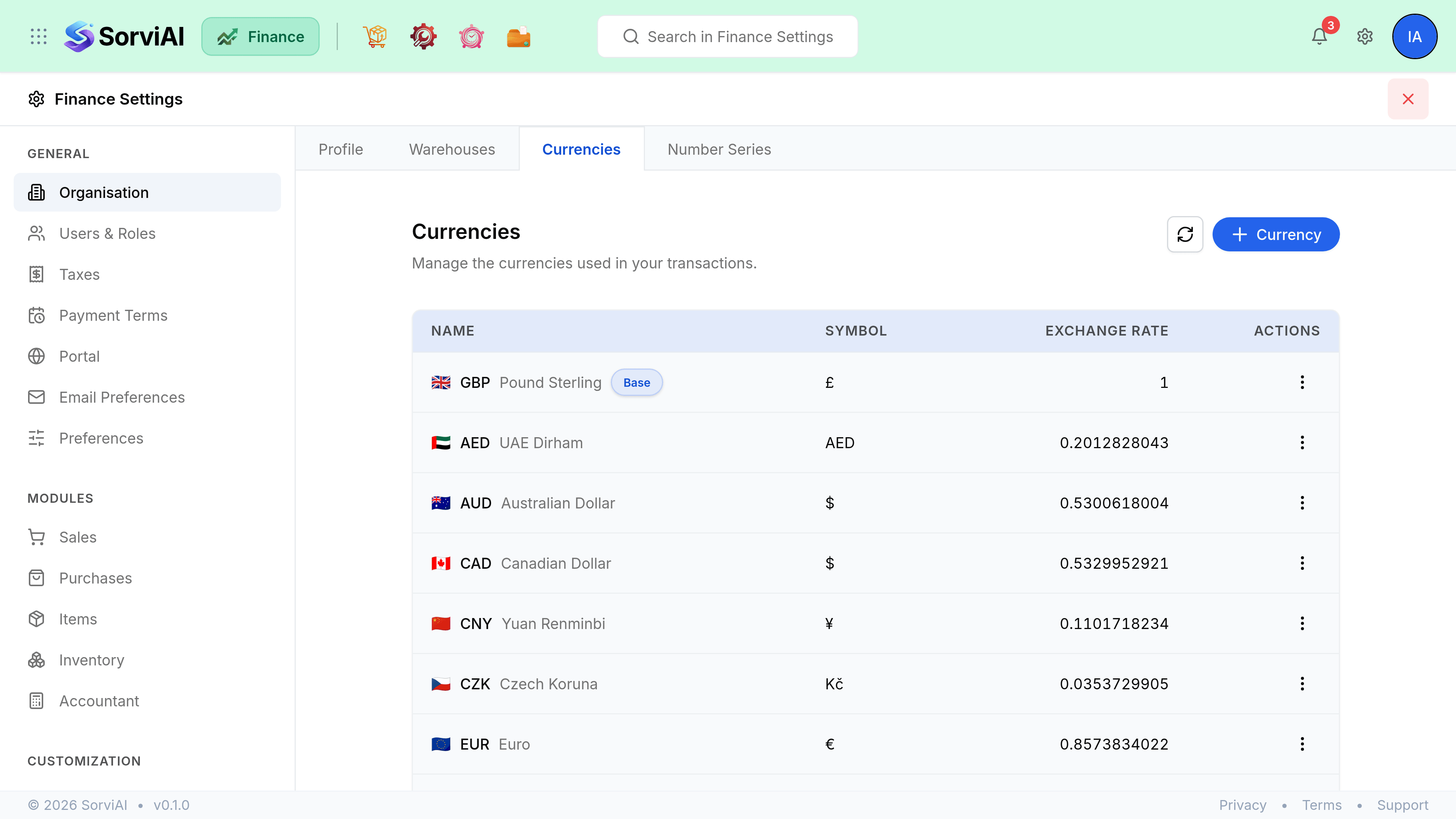
A customer or vendor carries a currency, and a document takes it from the contact, so adding a currency here is the first step in invoicing abroad.
Number Series
One row per document type, each with a prefix, a starting number and a restart rule.
| Field | What it does |
|---|---|
| Document Type | The document the sequence numbers, such as an invoice or a bill. The rows are tenant-wide, so what you set here is what the whole workspace issues. |
| Prefix | The text in front of the number, such as INV-. |
| Starting Number | Where the sequence begins. Changing it moves the next number; numbers already issued are untouched. |
| Restart | Never, or Yearly. Yearly takes the sequence back to the starting number at the turn of the year. |
| Preview | The next number the sequence will issue, recalculated as you type. |
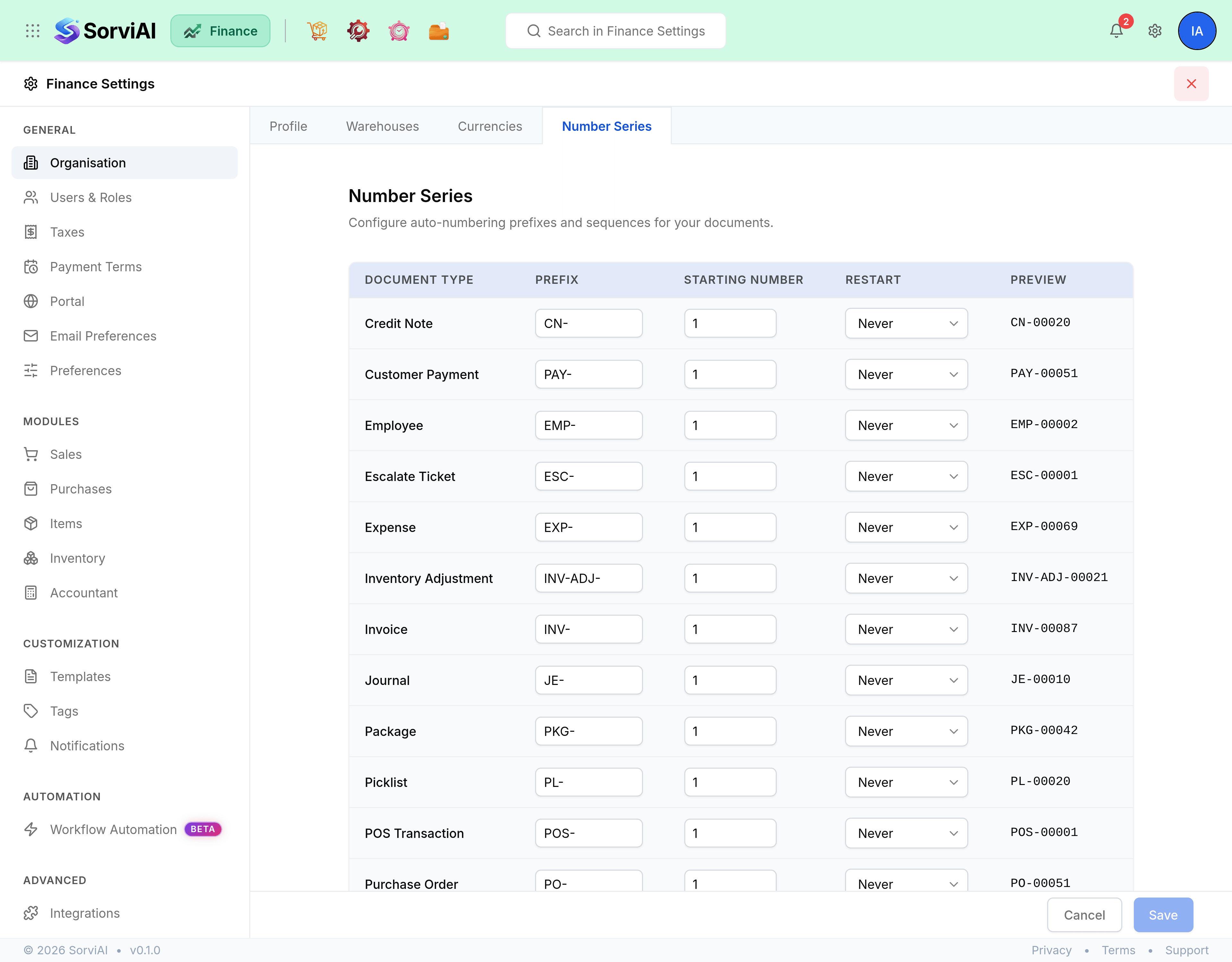
Go to Settings, Finance, Organisation, Number Series.
Edit the prefix, starting number or restart rule on the row you want.
Rows are editable in place; there is no separate edit mode.
Check the Preview column.
It shows exactly what the next document will be called.
Select Save.
Only the rows you changed are sent.