
Introduction - Invoices
The document that asks a customer for money, and its statuses.
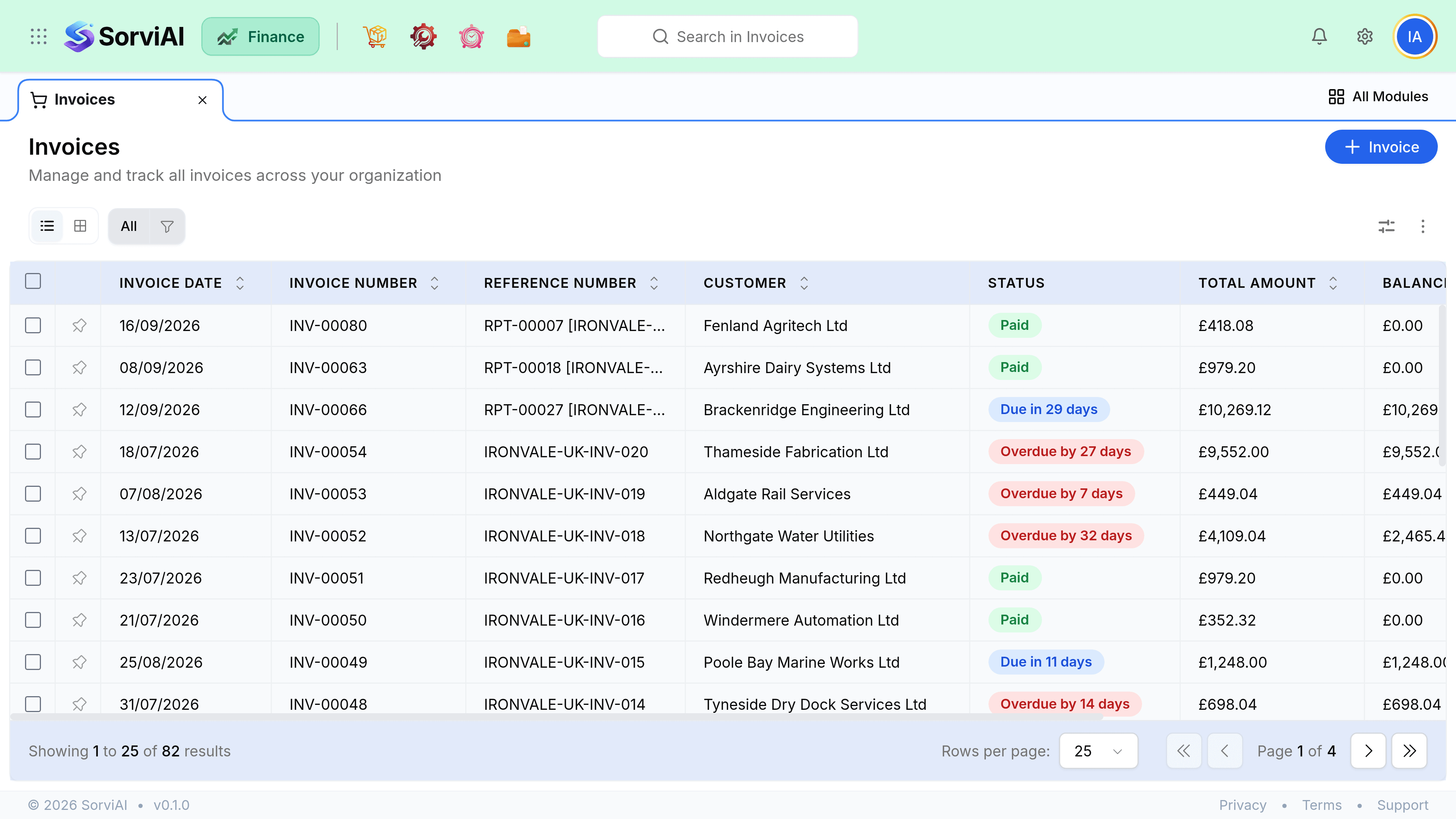
An invoice asks a customer for money. It lists items, quantities and tax, carries a due date from the customer's terms, and moves through statuses as it is sent and paid.
A draft invoice is yours to edit. A sent invoice is the customer's copy, so only a small set of fields can still be corrected. Payments recorded against it move it to partially paid and then paid.
Where an invoice comes from
Most invoices are not typed from scratch. Three of the four routes below carry their lines across for you, which is the whole reason the earlier documents exist.
- Quote acceptedConverted directly
- Sales order fulfilledBilled after shipping
- Recurring profileGenerated on a cycle
- InvoiceHowever it arrived
Raising one directly is the fourth route, and the right one when there was nothing to agree and nothing to ship.
The statuses in practice
| Status | How it gets there | What you can still do |
|---|---|---|
| Draft | Saved without sending. | Everything. Edit, delete, send. |
| Sent | Emailed or shared as a portal link. | Correct a small set of fields, record a payment, credit it. |
| Partially paid | A payment covers some of the balance. | Record more payments, credit the remainder. |
| Paid | Allocations cover the full balance. | Credit it, or refund the payment. |
| Overdue | Passed its due date unpaid. | Chase it. The status is derived, not set. |
| Void | Cancelled before it was ever paid. | Nothing. The number is kept and the value is zero. |
What an invoice is not
- It is not the money. A payment is a separate record, and matching the two is an allocation.
- It is not a deposit. Billing ahead of delivery is an advance invoice, because that money is a liability until you earn it.
- It is not editable once sent. Reverse the value with a credit note instead.