
Devices, serials and issues
Recording what came in, how you will recognise it again, and what is wrong with it.
Every service row on a ticket describes one piece of equipment and one thing wrong with it. Those three columns, the device, its serial number and its fault, are what make a repair findable a year later when the customer rings up about it.
Highlights
- One row per fault, not per visit. Two faults on one machine are two rows.
- The manufacturer is recorded beside the model, so similar models stay apart.
- Serial and IMEI are the same column with a switch between them.
- A fault can be picked from a list you build up rather than retyped each time.
- What you enter here prefills the work report, so it is worth entering properly.
The three identifying columns
| Field | What it does |
|---|---|
| Device | What the thing is. Search what you already have or type something new. The manufacturer shows in grey beside the model, so a Hattersley valve and a Pegler valve of the same size never get confused. |
| Device Issue | What is wrong with it, chosen from your fault list. Each entry carries a description and, where you have set them up, the parts that fault usually needs. |
| IMEI / Serial | How you will recognise this exact unit. The switch beside the box chooses which of the two you are recording, so the number means something rather than sitting in a general purpose field. |
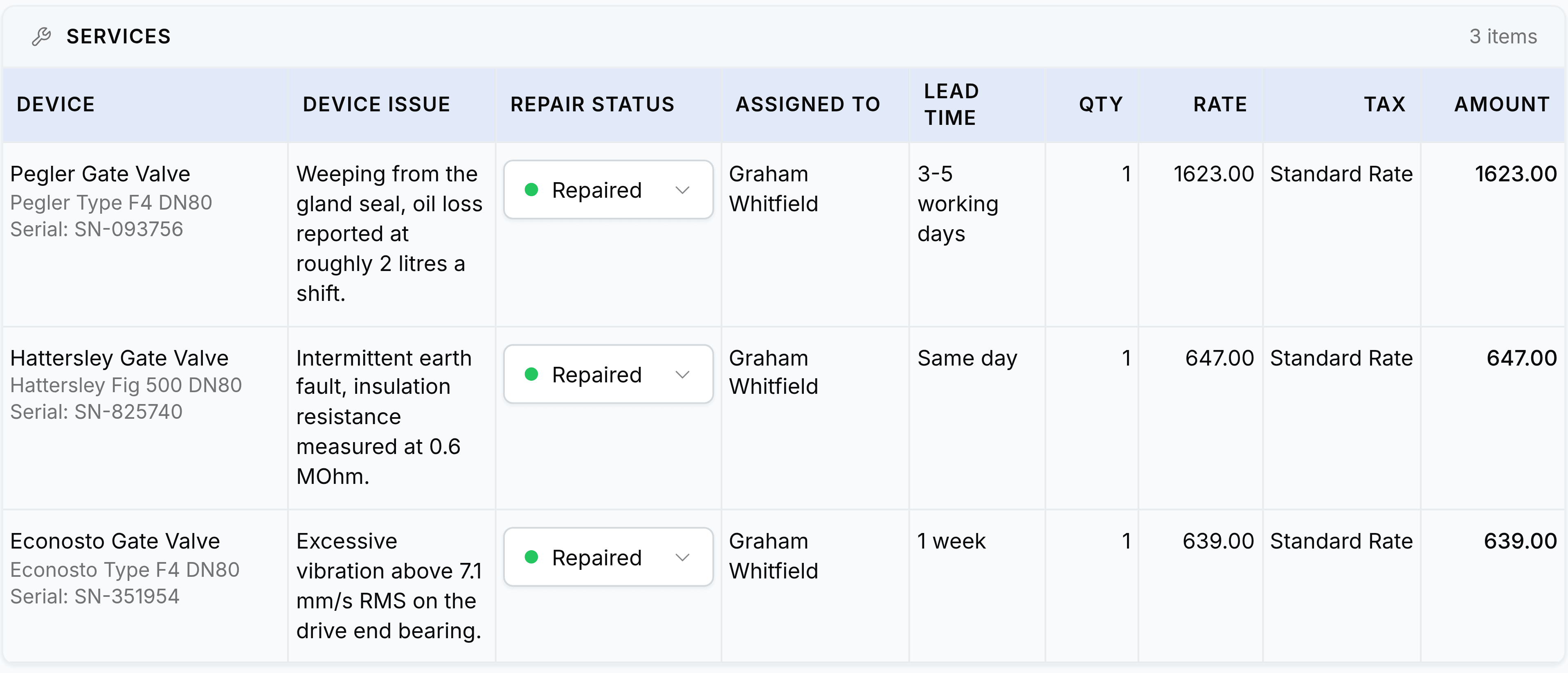
Writing a fault the next person can use
The fault text is read twice: once by the technician picking the job up, and once by the customer on the work report. Both are better served by a measurement than by an adjective.
| Instead of | Write |
|---|---|
| Leaking | Weeping from the gland seal, oil loss reported at roughly 2 litres a shift |
| Electrical fault | Intermittent earth fault, insulation resistance measured at 0.6 MOhm |
| Noisy | Excessive vibration above 7.1 mm/s RMS on the drive end bearing |
| Will not start | Tripping on overcurrent within ninety seconds of start-up |
Serial numbers earn their keep later
Nothing forces you to record a serial number, and it is the field most often skipped when the counter is busy. It is also the field that answers the three questions that cost the most time.
- Have we had this one before?
- Searching the serial number brings back every ticket that unit has ever appeared on, whoever owned it at the time.
- Is this still under warranty?
- A repeat repair is only visible as a repeat if both visits identify the same physical unit.
- Which of these four is the customer asking about?
- When one customer sends in four identical valves, the serial number is the only thing telling them apart.